
Design Technology
Creating The Future.
Engineers and designers are ready to tackle the next generation of global challenges we face, through creative solutions.
Spark, Influence and Provoke
Spark – students are given numerous opportunities and encouragement to take their own ideas and ‘run with them’. That first thought or idea can be inspired by their immediate or wider environment and can even be started by studying the work of others.
Influence – students' designs and products should have a profound effect on their target audience, alter trends and have a positive impact on society. Their work should dictate fashions and push the boundaries of what is possible.
Provoke – students' work should be groundbreaking and not always instantly appeal to all consumers. Their work should provoke discussion and debate and, if necessary, be contentious. Their work should challenge what society sees as acceptable.
Curriculum Intent
It is our vision to help foster and develop confident designers, fit for the future; ensuring they have the skills, resilience and confidence to deal with the challenges of modern life; To provide the wider community with individuals who are conscious of the role a designer plays in society and to prepare them for problems that don’t even exist yet; To establish a brand of designer who has both a broad range of technical abilities and a deeper understanding of the world around them, intervening to solve design problems.
Design and Technology (D&T) is an inspiring, rigorous and practical subject which prepares all young people to live and work in a designed and made world. Cultural capital is explored across the key stages by appreciation of the work of others locally, nationally and internationally. Each subject identifies and relates schemes of work to real contextual challenges focussing upon people, communities or businesses.
Design and Technology builds on the skills and knowledge pupils have already learnt at primary school. As a result of primary liaison and transition work, staff are well-informed of the pupils' starting point as they commence KS3.
The DT curriculum is collaboratively and coherently planned and sequenced across Years 7-9/GCSE to ensure that pupils build on all aspects of prior learning and stretches and challenges all pupils regardless of their starting point.
As pupils progress through Key Stage 3, they are given the opportunity to focus on specific areas of the subject, such as product design, food technology, engineering, mechanisms, electronics, and graphics. Pupils follow a rotation of work in 6 subject disciplines each year from years 7 to 9. Pupils work in mixed ability groups in year 7 and 8 and 9.
All teachers are made aware of any disadvantaged pupils on the DT department tracking sheets and class lists, all teachers are reminded of their responsibility to ensure that any obstacles to learning are removed. The department supports the needs of all pupils regardless of any potential barriers, as we believe in ‘success for all’. Close tracking of all pupils continues to be an intrinsic part of our monitoring in DT to ensure all pupils' progress is regularly reviewed and intervened/supported where appropriate.
Staff
- Mr T Mardle (Head of Department)
- Mr D Jones
- Mr P Ibbs
- Mr J Morris (School Technician DT and Art)
Resources
The department consists of three well-equipped workshops, with access to a dedicated CAD CAM centre and an additional state-of-the-art catering kitchen.
All workshops (T1 – T3) are equipped with industry standard machinery, computer-aided hardware and solid workbenches. Each workshop has a fully stocked, self-contained tool cupboard, interactive BenQ display board and lockable storage. In addition, each workshop has access to a vacuum former, two strip heaters, two hearths in a heat area, with aluminium casting capabilities, one spot welder, a welding bay with MiG and TiG welding equipment, an extraction cupboard, wood turning lathes and centre lathes.
The department’s CAD CAM suite (CC) comprises 25 PCs and 32 laptops which wirelessly connect to a variety of computer-aided hardware, including one laser cutter, three 3D printers, two vinyl cutters, a CNC Boxford mill and one CNC lathe. Software includes 2D design, Space Claim and Keyshots 9.0.
The department’s kitchen (T4) is equipped with stainless steel work surfaces throughout and catering standard hobs and ovens. The kitchen also has 2 electric ovens, a gas grill and a blast chiller.
The department also has a preparation room containing a table saw, chop saw and planer/thicknesser. DT is also lucky enough to have a dedicated DT technician who maintains, repairs, and prepares raw materials, machinery, displays and equipment in the department. Large storage areas for timber, metal, and polymers also mean the department is able to provide a vast range of resources.
Curriculum
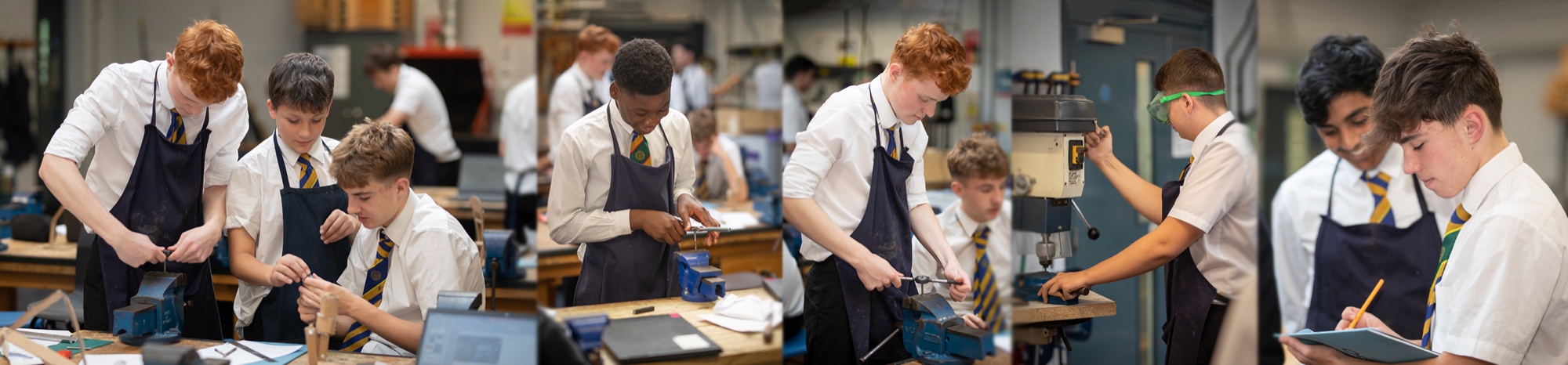
Students have opportunities to develop a wide range of practical skills and techniques including CAD/CAM designing and manufacturing, rapid prototyping, welding, drawing techniques, food hygiene and preparation to name a few.
Careers Zone
To support students with their option choices, GCSEs and A-levels, DT have their very own careers zone. This is an area that is specifically designed for students to analyse, read and interact with, whilst making important life choices.
Included in the careers zone are the top ten universities, across the UK, in Design Crafts, Engineering, Product Design and ‘other’ design courses. DT have also provided the college/university prospectus for each of the top ten, plus additional businesses and course available at GCSE, A level and Degree.
In addition to the specific college or university information, Mr Mardle has also included Alumni documents, which provide the students at SGS with extra information they might need to know about the courses, qualifications and towns/cities themselves.
The careers zone also contains information about local, national and international companies should students want to pursue apprenticeships and/or the world of work. These include JCB, Progressive CNC (Peterborough), Gutteridge (Spalding), Dyson, Perkins (Peterborough) and many more.
As a department, we also hold webinars, seminars and welcome visitors to our department. These include SGS DT alumni, universities and national companies, all of which feed into our department careers provision.
If you or anyone in your family has since left SGS and followed a career in Design or Engineering, please contact Mr Mardle (tmardle@spaldinggrammar.lincs.sch.uk) and he would be very happy to advertise you and your career path.
If you or anyone in your family has since left SGS and runs a business in Design or Engineering, please contact Mr Mardle (tmardle@spaldinggrammar.lincs.sch.uk) and he would be very happy to advertise you and your career path/company